And such is the Nature of Evil

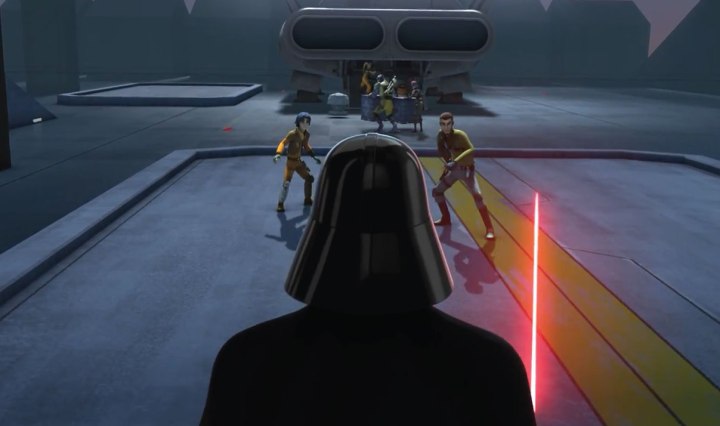
The two great mythologies of the last 60 years, Lord of The Rings/The Hobbit and the Star Wars Saga, both attempt to give insight into the origin and reason of existence of Evil. If there is any conclusion to be drawn from the way in which Evil is depicted, or hidden in plain sight, in these stories then it seems the conclusion that Evil is something your recognize when you see it, but that eludes a real definition. Many perceive Star Wars (and also Lord of the Rings) as a simply black-and-white tale of Good versus Evil, but it isn’t. In this post I want to have a closer look at some aspects of this. Continue reading “And such is the Nature of Evil”

Padme in 'Bombad Jedi'

‘Bombad Jedi’: Working Against Stereotype

I am currently on a rewatch of the 200The Clone Wars series and realized that S1E08, ‘Bombad Jedi’ is an absolutely fascinating episode! Not only funny, it gives room to some major development for two of Star Wars‘ most interesting characters: Padmé Amidala and Jar Jar Binks. ‘Bombad Jedi’ works on a lot of different levels, reintroducing the political element of the Clone Wars and showing how war leads to suffering and betrayal. The episode, directed by Jesse Yeh, starts with the fortune cookie-esque ‘Heroes are made by the times‘, but rather than focus on our accepted heroes, Anakin Skywalker or Obi-Wan Kenobi, the episode goes out of its way to show that heroism exists on different levels and can be found in everyone.

From the very start of the episode it is clear that Padmé is in control of this mission. Her unwavering loyalty to her friends has brought her into dangerous territory and yet she goes there believing in the strength of diplomacy and peace, in itself the start of a very heroic quest. In choosing Jar Jar as her companion, she also reveals her recognition of similar principles in Jar Jar. Chancellor Palpatine functions as a good point of contrast to her behaviour when he mocks Jar Jar’s “qualifications”. He not only disregards JarJar but also looks at him with contempt, unable to see the potential Jar Jar holds. Palpatine respects martial strength and Jar Jar’s own brand of strength is not something he recognizes, initially. In some ways this is similar to how he considered Padmé naive in The Phantom Menace only to have to admit by the end of the film that she is a lot stronger than he thought.

Continue reading “‘Bombad Jedi’: Working Against Stereotype”

Asajj Ventress on Teth - starwars.wikia.com

‘I am fear’: Asajj Ventress and the Strong Woman

AsajjventressheadshotobsessionAsajj Ventress, as voiced by Nika Futterman, is a character that fascinated me, and many others, from the first moment she graced our screens in Star Wars: The Clone Wars, both film and series. Initially introduced as a Commander in the Separatists’ army and an apprentice to Count Dooku, Asajj Ventress is a feared force in the galaxy during the Clone Wars and the nemesis of Obi-Wan Kenobi and Anakin Skywalker. Although this post will largely focus on her portrayal in the 2008 TV show, it is worth mentioning that many of the things briefly mentioned below are worked out in great detail in comic books and novels which are all worth reading. This post will contain spoilers for those who haven’t watched Star Wars: The Clone Wars in its entirety.

In the comic series Star Wars: Obsession Asajj says of herself:

“I am fear.”

Ingeniously, this applies to her character in two ways. On the one hand she is a woman feared throughout the galaxy because of her strength and her ruthlessness. On the other hand, she is a woman who is terribly afraid herself. Asajj is a character who is frequently used as a pawn by others. Most notable in that respect is her relationship with Count Dooku, starting when he presents her to Darth Sidious who sends her out to kill Anakin Skywalker. She is used by both men to further their own agenda. Dooku shows his loyalty to Sidious and Sidious is able to trigger Anakin to use his anger as a way of defeating his enemies. After this defeat, Asajj becomes an assassin for Dooku while always hungering to be trained as a full Sith. She is kept on the periphery by Dooku and Sidious, never fully trained, never fully accepted, which means she is constantly striving to prove herself to others and fearing that she is lacking. This comes to a close in the 12th episode of the third season of The Clone Wars when Sidious starts to consider her a threat and orders Dooku to eliminate her. He does so by betraying her during the Battle of Sullust and she is left for dead.

Continue reading “‘I am fear’: Asajj Ventress and the Strong Woman”

The Prequel Trilogy & the Noughties

The Phantom Menace is still widely considered to be the most anticipated film in history and only The Force Awakens seems to be a contender of taking that title. The Prequel Trilogy however divided audiences in a manner very different from how the Original Trilogy had. I argued that Original Trilogy had been a defining cultural moment for a new generation due to its strong resonance with the world events as well as the daily lives of young people between ’77 and ’83. For the Prequel Trilogy this is even more true. However by ’99 the world had changed dramatically since ’83 and was on the verge of further dramatic change. This not only shaped the reception of the films, it shaped the divide that ensued.

Continue reading “The Prequel Trilogy & the Noughties”

The Original Trilogy & The Eighties

There are legion reviews that describe in detail the state of the world as it lead up to first screening of Star Wars in 1977. Usually those essays, blogs, and documentaries then focus on the impact of Star Wars as a blockbuster phenomenon on (pop-) culture. The idea of such analyses is that there was something about the world before Star Wars that made us embrace it. I will take a different point of view in this article. My thesis is that it was the series of historical events and developments that occurred simultaneously with the Original Trilogy’s release and reception that can illuminate why this set of movies had such a huge impact in culture.

I want to take you on this journey from my personal point of view. That will be different from Obi Wan’s and probably also is different from yours. But I hope my thoughts may nevertheless contain interesting insights for you as well, reader. Continue reading “The Original Trilogy & The Eighties”

Padme Amidala in 'The Phantom Menace' - from http://starwarsscreencaps.com

Scene It? – Padme’s Choice on Mustafar

scene it 2In today’s Scene It? post I’ll be looking at one of the most heart-breaking scenes in The Revenge of the Sith (2005), the third prequel film which depicts Anakin’s switch to the Dark Side of the Force. I am, of course, talking about the scene between Padme and Anakin on Mustafar, shortly before the battle between Anakin and Obi-Wan. Naturally, this post contains spoilers for The Revenge of the Sith. If you want a quick refresher on the scene, help yourself to the video below, the first half of which I will be discussing:
Some of the criticism directed towards RotS focused on the development of Padme Amidala’s character. In The Phantom Menace she is a young queen, exclusively focused on saving her planet from being taken over by the Trade Federation. In The Attack of the Clones she returns as a senator of Naboo and a key senator in trying to stop the outbreak of a war. We also see her trying to cope with her feelings for Anakin Skywalker and fighting for her life. In The Revenge of the Sith, Padme and Anakin are married, with the twins on the way, while she continues in her role as senator. As the Republic falls apart, so, it could be argued, does everything she has worked for. The difficulty with which Padme switches between her roles as  senator and wife is, I believe, on purpose.  As Anakin slowly loses himself it becomes harder for her to unite her principles with her emotions. The reason this scene is heart-breaking is because everything Padme believed in has either been corrupted or fallen apart. Below I will discuss why her choice of response to this is one which is probably singular in modern cinema and makes her stand out as one of the strongest women in sci-fi.

Continue reading “Scene It? – Padme’s Choice on Mustafar”

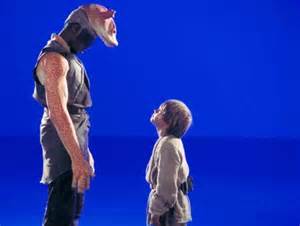
Ahmed Best and Jake Lloyd

Parallel Lives: Jar Jar and Anakin

When George Lucas made the choice to start the Prequel Trilogy with Anakin Skywalker as a kid and to include Jar Jar Binks as a character he must have had an inkling of what was coming. But he must have made this choice deliberately because of its story-telling value. In this post I want to have a look at how intimately the stories of these two great characters are entangled and how they mirror each other. Unwittingly, in their joint rejection of these two, the prequel-bashing community not only misses out on a vital element of the story Lucas tried to convey. But above all they confirm the message that is in Jar Jar and Anakin’s story for those who did make the effort to recognize it.

Continue reading “Parallel Lives: Jar Jar and Anakin”

Scene it? – Anakin and the Sandpeople

scene it 2Scene It? is a feature we’re hoping to do frequently, if maybe not each week. As the title may suggest, we’ll be looking at different scenes within the Star Wars-canon and analyse how they can be interpreted.

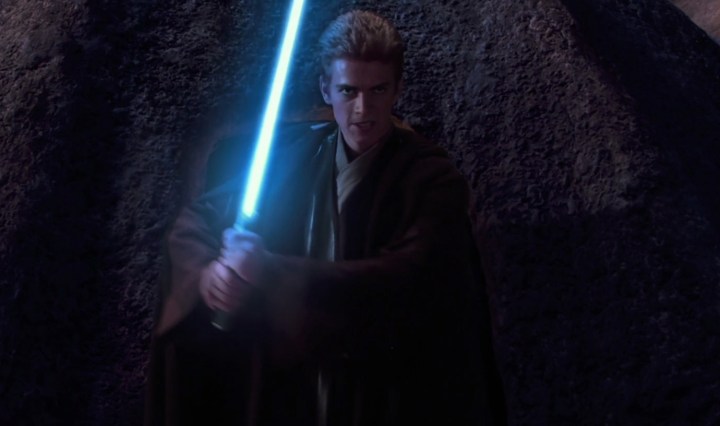
Today I want to look at a scene that I believe is crucial to the development of Anakin Skywalker and sets him on the path to the Dark Side. This is the scene between Anakin and his mother, followed by the slaughter of the Sandpeople and Anakin dealing with the consequences of his actions. In the second prequel film The Attack of the Clones (2002) Anakin Skywalker goes through an enormous amount of development. The last time we see him he was a child, who had left home behind and was about to start training as a Jedi-padawan. In TAoC, Anakin has grown into a young man who is struggling with being mature at all times. He is torn between following his emotions and his high expectations of himself.

The scenes on Tatooine are truly tragic and, for the first time, we see Anakin take a conscious step towards the Dark Side. Shortly after finding his mother, she dies in his arms before being able to say she loves him. George Lucas and Hayden Christensen show us an Anakin who is already conflicted between what he knows is right and what he feels. I want to spend some time analysing what happens in this moment to show how delicate the film is in showing us Anakin’s development. The two scenes in the video above are the ones I will be looking at.

Continue reading “Scene it? – Anakin and the Sandpeople”