
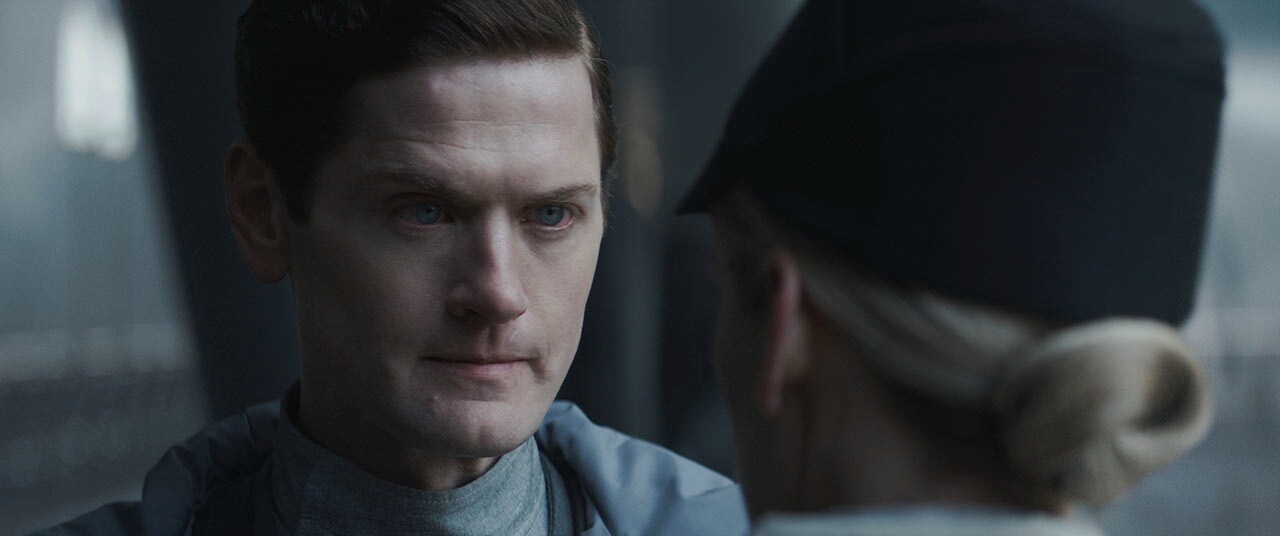
Syril Karn is one of the most interesting characters to come out of the two seasons of Star Wars: Andor. He is a character that defies stereotypical characterisations. But what is perhaps most disconcerting about Syril, is that he is so much like you and like me … more so than we are likely to want to admit to. This posts contains spoilers for seasons 1 and 2 of Andor.
Finding Syril Karn
We encounter Syril early on in Season 1 of Star Wars: Andor. He is an employee of the Morlana Security Corporation. One who takes his job seriously, perhaps too seriously, but still seriously. We first meet him when he alerts his boss to the killing of two of the company’s security staff. Syril sees the crime, he sees it very clearly: the two are dead. Syril however does not see the context. This is not just some character flaw however. It won’t be the last time that Syril’s actions, and consequently his fate in the series, are determined by his struggle with context. But before we put this down to some kind of, possible, neurodivergence we must add another ingredient. Not only does he not see context, he does not care about context. In early Syril’s universe a crime is a crime, no matter the context.
This is immediately obvious in the first episode in which he appears. He is in the office with his boss, who is a wool-dyed senior and who immediately sees context. The two security staff were in an establishment where they were not supposed to be, probably had a few too many, and decided to get into a brawl with the wrong person. As viewers we know this is pretty close to the truth, because unlike Syril we have seen the immediate lead up to the killing of these two men. Where the death of one can be put aside an accidental, the killing of the second was a downright execution. The perpetrator of this crime? None other than our hero, Cassian Andor! The good guy, right? Wrong! At this point in the story Cassian is not much of a good guy. Again … context matters, and this is also context Syril does not know about. The way Cassian executes the second Morlana security staff suggests this is not his first killing. The mix of coldblooded anger and fear of revelation pushes him towards a dark line of action. Interestingly the show does not try to apologise for his actions. In subsequent scenes, it becomes clear Cassian exploits the people he has relationships with, his friends, Basso, Bix and, yes also his mother and her droid B2-EM0. It is also clear however that the only reason why these people stick with him, is because they have higher expectations of him and have not yet lost hope.
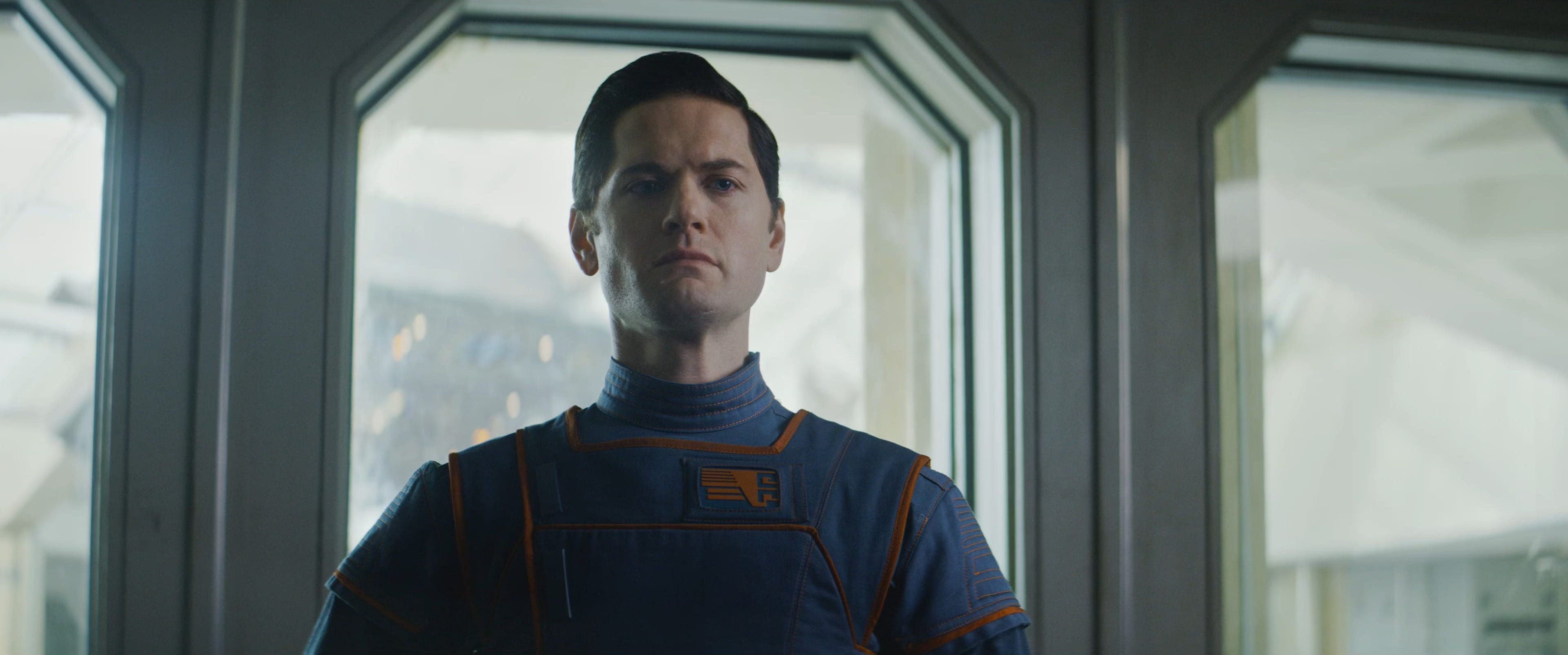
Syril knows none of these aspects. Syril only sees two dead men, one shot in the face, and sees a crime. He does not care to find out context, after all in his universe a crime is a crime. Many viewers will struggle with that view. We are trained to quickly forgive the heroes, or to shower them with easy forgiveness without atonement. They’re supposed to be heroes after all. But probably most viewers felt a pinch of uneasiness at Cassian’s actions as well as his subsequent dealings with friends from Ferrix. Syril, in the mean time, struggles with the response of his boss who deduces from the context that this whole affair be best covered-up and forgotten. That’s where Syril’s story begins, with the inability to accept that crime is left unpunished. We are shown how Syril cares about the detail of his uniform, about the detail of his hair, he cares about appearances but also about principle. Somewhere in that quagmire of ego-pleasing appearance and stubborn principledness do we find Syril Karn.
Performative justice
To paraphrase Legasov from “Chernobyl”, to Syril ‘a just world, is a sane world‘. There is not a lot of sanity in Syril’s world. He cannot let go of his desire to solve the crime of the two deaths, and he cannot recognise he is in league with fellows who are neither overly smart about things, not overly motivated when it comes to a desire for justice. Syril’s attempt to arrest and detain Cassian on Ferrix is an unmitigated disaster. Syril is in over his head, his failure to see context means he also fails to recognize that the forces he is awakening on the Imperial side, as well as on the side of the emerging Rebellion, are far above his paygrade. As a result, the mercenary that Cassian is at this moment finds a paid job within the Rebellion, and Syril loses his paid job at Morlana while the company is ‘nationalised’ into the Imperial Security Bureau (ISB). Syril’s attempt at performative justice has ruined his career, Cassian’s crime has won him an unexpected bounty.
After this debacle Syril has apparently no other opportunity than to move in with his abusive mother in Coruscant. It is unlikely that he is just ‘lazy’ because nothing in his arc so far suggests he would not be able tor willing to go to extreme efforts. Through the corrupt Uncle Harlow Syril gets a ‘second chance’ at the Bureau of Standards. But Syril is stubbornly principled. Partially this now leads him actually to a kind of success. In the Bureau of Standards, his principled stance combined with his lack of appreciation of the context of crime leads him to uncover a corruption scandal. An achievement that eventually lands him a promotion. It is only a side-story and doesn’t get much screen-time, but it matters in understanding Syril as it is a direct affirmation what he believed already. Due to his lack of attention to context he evidently does not recognize the role of Imperial corruption in all of this. But at least this time his performative justice does not involve the terrorizing of the innocent population of a town, or the deaths of colleagues.
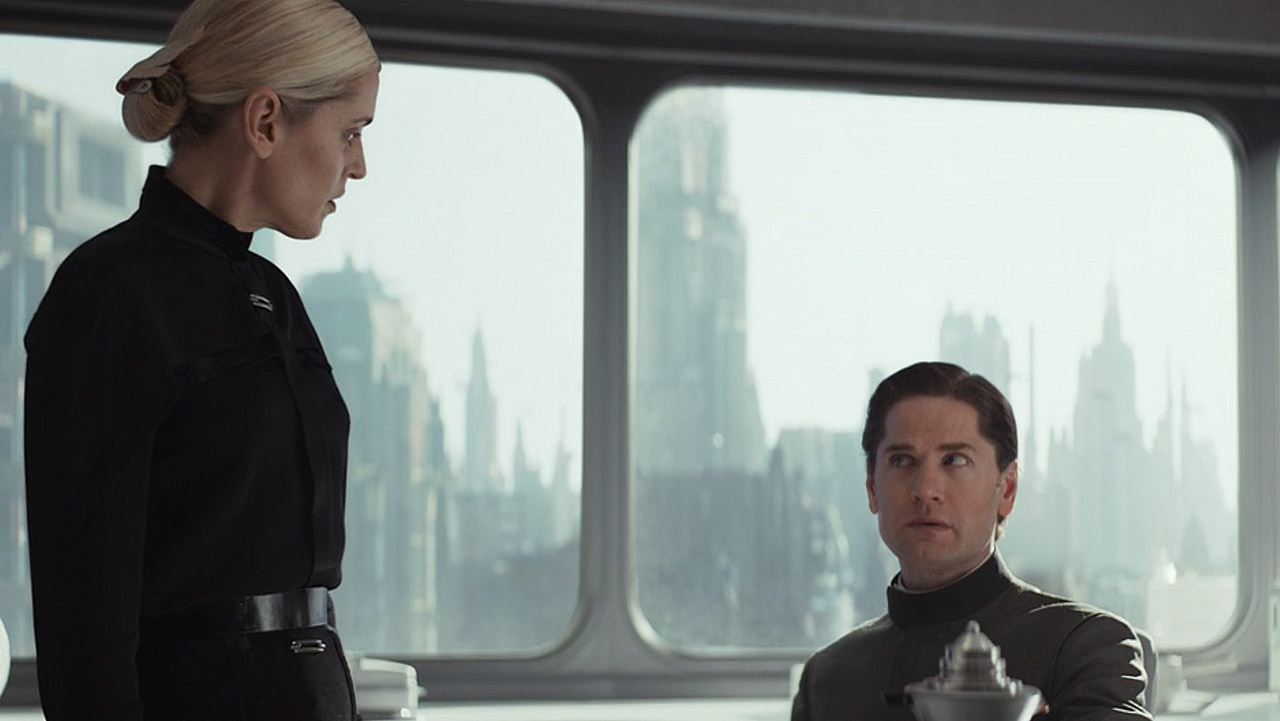
This is also when he falls for Dedra Miro, the ISB supervisor. She embodies for Syril everything Syril admires and values: determination, unwavering loyalty, perseverance and success. Watching these episodes carefully, a viewer should notice that at no time in this entire arc is there any hint or suggestion Syril’s attachment to Dedra is sexual. She finds his attention for her inappropriate and shows quite a bit of disdain for him. But Syril is blind in admiration and … in all fairness … used to abuse from people close to him. He lives it every day. Syril has not forgotten what got him into the situation he is in, and in his admiration for Dedra he wants to prove his value to her by trying to get her to take the information he has about Cassian seriously. It backfires. But when he saves Dedra’s life in the season finale, things turn. By that time we as viewers already know that Dedra is anything but a principled fighter for justice. For her the Empire is a path for advancement, a struggle as a woman in which we almost root for her, if she weren’t such a ruthless fascist.
Exploit the ones you love
In season two, Dedra and Syril have become a ‘thing’. They are clearly in a relationship, have moved together, and Dedra has driven a hard bargain with Syril’s mother to limit the abuse of Syril to whatever Dedra is willing to tolerate. It is only here that we start seeing some physicality in the relationship between Syril and Dedra, but Dedra seems the driver of this. When I counted correctly, it is suggested in one scene they have sex off-screen (with the lights out) and there are two on-screen kisses. The latter are both manipulative. Syril is in a relationship with Dedra, but for Dedra Syril is just another vehicle in her climb to the top … or at least so she thinks for most of the season.
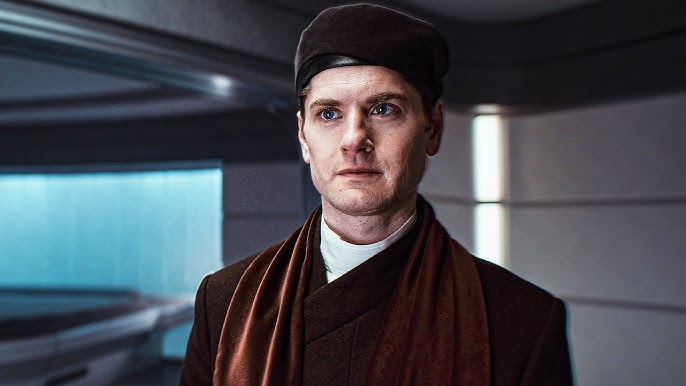
As part of that ‘use’ she makes of Syril, he needs to go to Ghorman, on a mission for the ISB. A mission of which he is knowingly kept in the dark, including by Dedra. But for Syril Ghorman is a sea-change. Although he is aware that he was sent here by the Empire, he actually believes in his mission and doesn’t consider it a ruse for a far more deceitful and criminal purpose. Yet, his naive belief he is doing the right thing gives him a type of agency we have not seen him display in season 1. Was he before a Morlana security ‘clerk’ who compulsively corrected his uniform and tweaked so as to look as imperial as possible, on Ghorman he develops a taste for dress that not only makes him ‘fit in’ but that even changes his face. Syril is increasingly at ease, gone are the overly nervous, tortured, and tight facial expressions.
The way Syril is framed in the scenes he has with the Ghorman Rebels, he seems increasingly believing he genuinely is acting also in their best interests, at least according to how he believes the Empire sees those. Again, his lack of appreciation of context is what blinds him to what is actually going on. Where Dedra seems to have no qualms using Syril, Syril has few if any operating amongst the Ghorman Rebels.
Catastrophe
Syril’s arc thus becomes inextricably entwined with the fate of the Ghormans. He as deceiver is being deceived himself. As someone who believed he was facilitating justice, and that a just world is a sane world, is confronted with the fact that he was facilitating a heinous crime and genocidal insanity. This personal catastrophe for Syril happens minutes before the actual genocide. His eyes have already seen enough, his ears have heard enough, by the time he barges into Dedra’s office on Ghorman, with the view towards Ghorman Plaza where the fuse to the genocide is about to be lit.
This is a scene which caused some controversy. Many viewers remarked how Syril’s behaviour towards Dedra reminded them of the kind of domestic violence and abuse that too many women, past, and present, fall victim to. Especially Syril’s grip at Dedra’s throat, seemingly in an attempt to throttle her, has concerned many viewers. But here too, context matters. It is a rather twisted scene, in which Syril evidently violates Dedra’s personal space and commits violence against her, although before he harms her physically he recoils at her confession. Dedra in that moment seems to think that there could still be a relationship after all of this when they go home with ‘rewards’. Living in the coercive and violent world of the ISB has surely left its marks on her. For Syril this is the moment where he crosses the line, not in terms of violence towards Dedra but in terms of abandoning her and the Empire. Although he knows it will threaten his personal safety, he mingles among the Ghorman crowd on the Plaza … awaiting what comes.
Dedra seems to realize something has broken, but cannot find the courage or strength, not to pass on the order, nor the courage to also defect. The latter seems not to have been on her mind as a possibility at all. She gives the order to ‘proceed’ even though she knows what’s coming and that Syril is in the midst of it. In the aftermath of it, a scene makes clear that all of this has not gone without trauma on her side. But she deals with it in the way she has likely always dealt with it: she shows her emotions in a closed space, away from anyone’s sight, and then she straightens her jacket and moves on.
Syril on the other hand … lost and aimless he wanders through the crowd that gets massacred around him. Until he sees Cassian, and his anger and rage gushes forth uncontained and directed against Cassian. Oh irony, in doing so he saves Dedra’s life without either of them knowing it. Oh even deeper irony, in Dedra surviving this a year before the last arc of season 2 it is very likely Dedra’s colleague Lonnie Jung only acquires her code cert after Ghorman. In a twisted way, Syril’s action is what allows the secrets of the Death Start to leak out of Dedra’s accounts to the Rebellion.
But Syril’s catastrophe has a final gesture. In the chaos of the Gorman genocide Cassian and Syril battle it out, hand-to-hand. But the moment Syril has the upper hand, because he got hold of the only weapon in the room, and Cassian asks him in bewilderment who he is … Syril lower the gun, just before he himself gets shot.

Another gesture that ultimate contributes to Cassian surviving, and Cassian and Jyn Erso delivering the Death Star plans to the Rebellion.
Is Syril us?
I guess none of us want to be Syril. If we contribute to the liberation of a galaxy, we’d prefer to do it because of deliberate intentional choice. Surely, we would never be as blind to context as Syril is! Surely, we would never knowingly support a fascist empire! Surely, we are so very different from those who do! We think of Luthen as a Rebellion hero, despite him being someone who murders friends and allies without a second thought or remorse when he thinks it serves the cause. We think of Cassian as a hero, despite his beginnings as an exploitative, abusive, broken man, and his slow emergence as a resistance fighter only after experiencing why resistance is necessary. Cassian never shows any remorse, always rationalizes his way out of the killings, even when he sees on Bix’s face that she struggles with his ease at doing so.
Syril makes a moral choice, but he makes it too late. Syril finally sees context, but only at the end. But when he does … he makes the right choice and lowers his gun. Some will say Cassian’s question stunned him, he just lowered the gun because he didn’t know how to answer. Really? Wouldn’t that have given him even more incentive to pull the trigger. Cassian wasn’t the first one to ask Syril that on the day. The person who ultimately kills Syril asked him several hours prior. Following that Syril has been asking him self that as well. Syril’s moral choice consists of choosing, in that final moment, what, or who, he is not. He doesn’t get to live that choice … but Cassian gets to live that choice.
Conclusion
We as humans are very often blinded by our own righteousness, unable to see context. We frequently prefer judgement over understanding or comprehension. In fact, we often instinctively equate understanding with permissiveness or condonement. Our deeply felt aversion against understanding those we abhor is mostly just evidence of how we prefer to lock-out context that is unwelcome. Syril is doing all that, is displaying that same rigidness and in his case it makes him vulnerable to imperial manipulations. Just like many of us. Some of us have the bad luck that we are manipulated by a terrorist organisation, a billionaire’s (social) media platform, or an algorithm that feeds a daily dose of poison into our brains. Some of us are lucky, that we are manipulated into being on the right side of history … this time.
But being manipulated is not inevitable! Feeling an urge to judge misbehaviour, corruption or crime we see around us is not just a negative. There is room for judgement as long as we remember we have judges and a judicial system precisely because we are aware of human flaws we also share. It is exactly when we strive for power to be contained, be it billionaire power, religious power, or the power of a narrow majoritan mandate. It’s why we have a division of powers between elected and unelected parts of a state. Context always matters because very often it is the context that strongly influences what is crime and what is not. A world of performative justice may seem sane to some, but will appear insanity to another. Due process however, how inconvenient it might seem, and how much we might year for certain cases to be decided quickly and without hesitation because the judgement seems obvious to our eyes, is what prevent us from being early Syril. If we insist on being like him, even while admonishing everyone who says we are, then our only hope is that we, by accident or fate, nevertheless contribute to the liberation of a galaxy from tyranny.
 Clone Corridor